Reflection Pool
A Phygital Immersive Interface to encourage novel emotional connection with Chau Chak Wing Museum Exhibits.
CONTEXT
The challenge was in the brief’s focus on ‘future-proofing’ as it is seen in global trends that attendance at museums is declining. London, for example, has seen significant declines in attendance at the British National Museum, National Gallery, and National Portrait Gallery of 2.4 million visitors (16%) between 2015 and late 2018 (Pes, 2018).
I was part of a team of three, where I contributed to the research plan, research session moderation, analysis and synthesis, transcription, graphic design, 3D modelling and printing, videography, and video editing.
Our team focused on the experiences of young adults (defined as anyone within the age range of 18-30 years old) as our target demographic. Our group concluded that the need for future-proofing of the museum experience was a direct call out to facilitate younger population groups. A reported 6.9% decrease in trips to museums for education, and participation in on-site activities for under-18s was reported in British museums in 2017, suggesting a decrease in cultural investment for younger generations (Jones, 2017).
As such, Chau Chak Wing Museum, located in Camperdown, tasked us to explore how to 'Future-Proof' the Chau Chak Wing Museum within the lens of Experiential Design.
PROBLEM
In order to understand how young adults behave in group settings to inform our team on how we might promote serendipitous museum experiences to young adults, four research questions were formed:
How do young adults connect with the past in museums? How are artefacts in museums interacted with when connecting with heritage or disparate cultures?
How do young adults socialise in museums? How does interpersonal communication of experiences lead to deeper discovery?
How do young adults navigate the museum experience?
What do young adults find appealing and unappealing about the museum experience?
RESEARCH
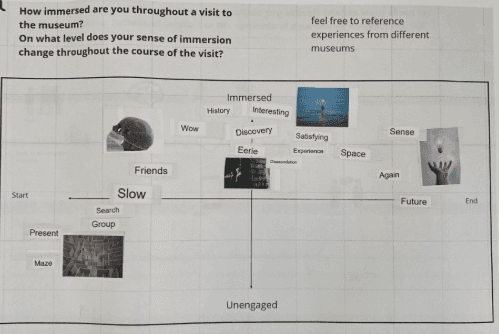
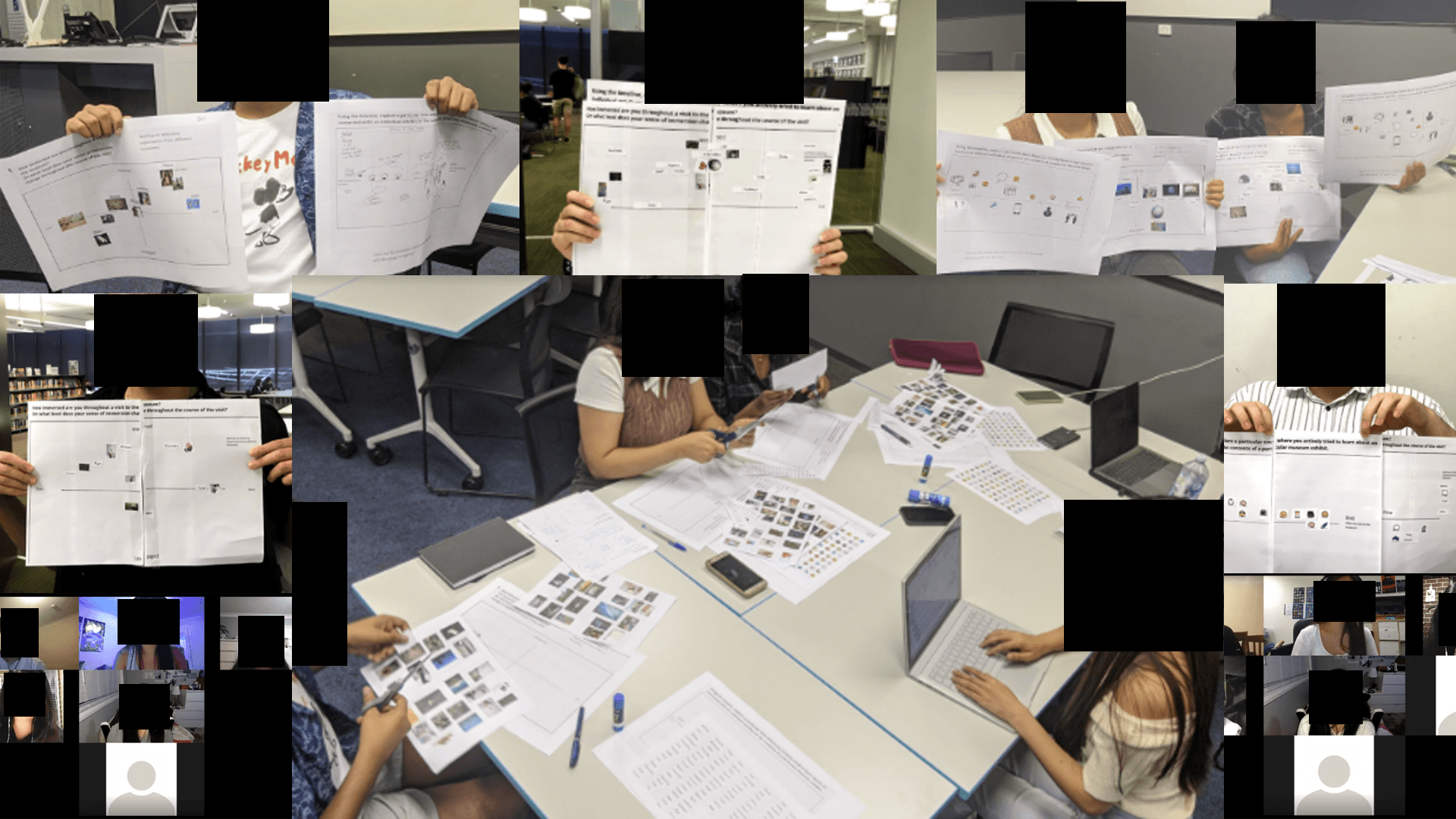
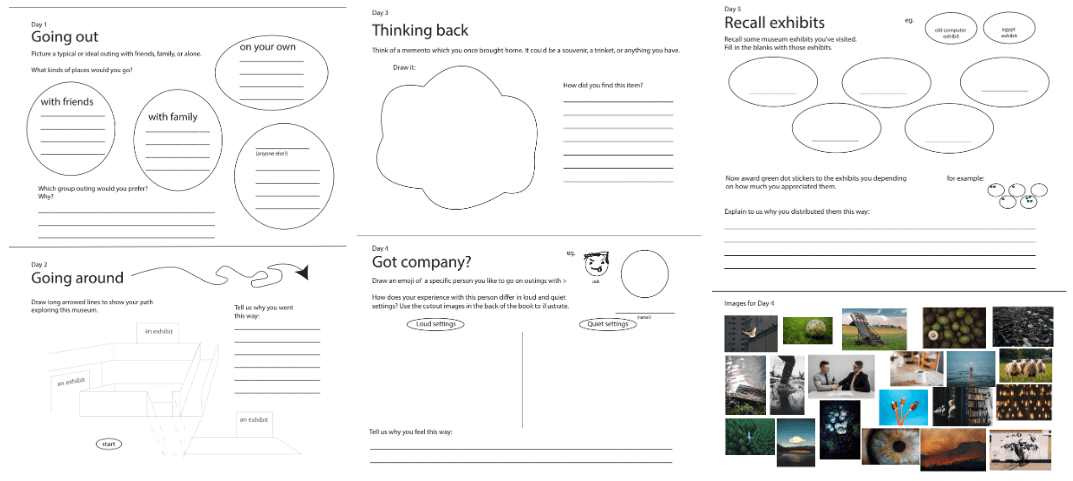
Design methods as described by M. Tomitsch et. al. in Design. Think. Make. Break. Repeat. Were used for this study in three 2-hour group sessions.These included preliminary five-page Sensitising Exercise Booklets, Collage Mapping and Cognitive Mapping (with contextual observation), and Laddering Interviews based on the outcomes of the previous exercises.
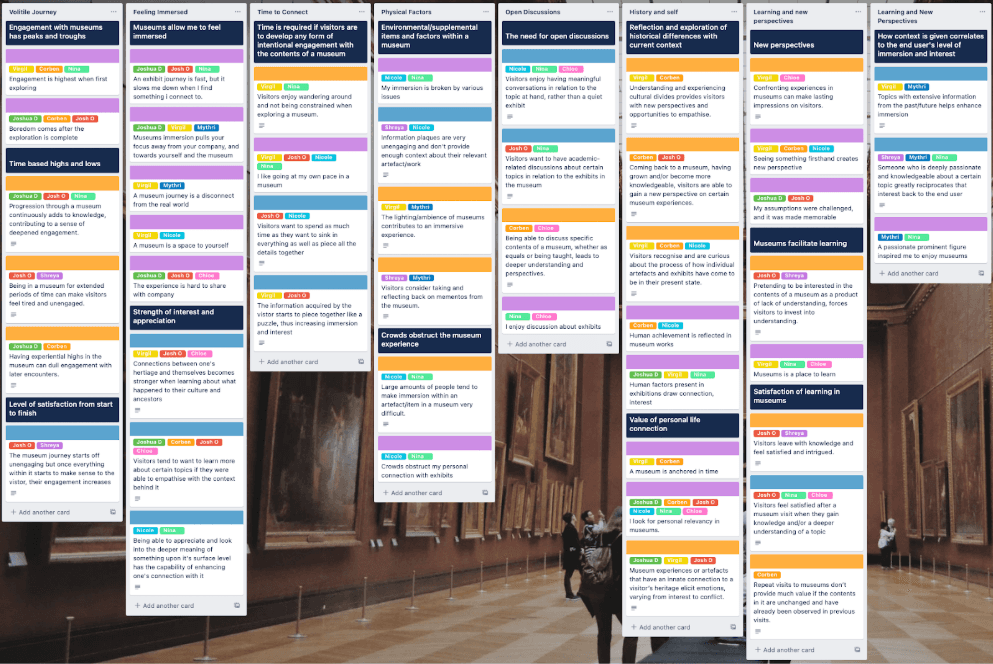
Each member of the team was required to analyse the data acquired from all completed generative sessions and create statement cards for group discussion and analysis, to reduce affirmative bias.
Each statement card features at least two insightful quotes from all session transcripts that align under a single theme. In a collaborative session, group members first grouped together their own statement cards to dictate their findings. We discussed similarities, differences, and any interesting insights before trying to formulate new categories that can be formed by regrouping some statement cards.
This approach ended up yielding a large quantity of difficult-to-interpret qualitative data, so that only insights from interviews was considered reliable enough to form insights.
INSIGHTS
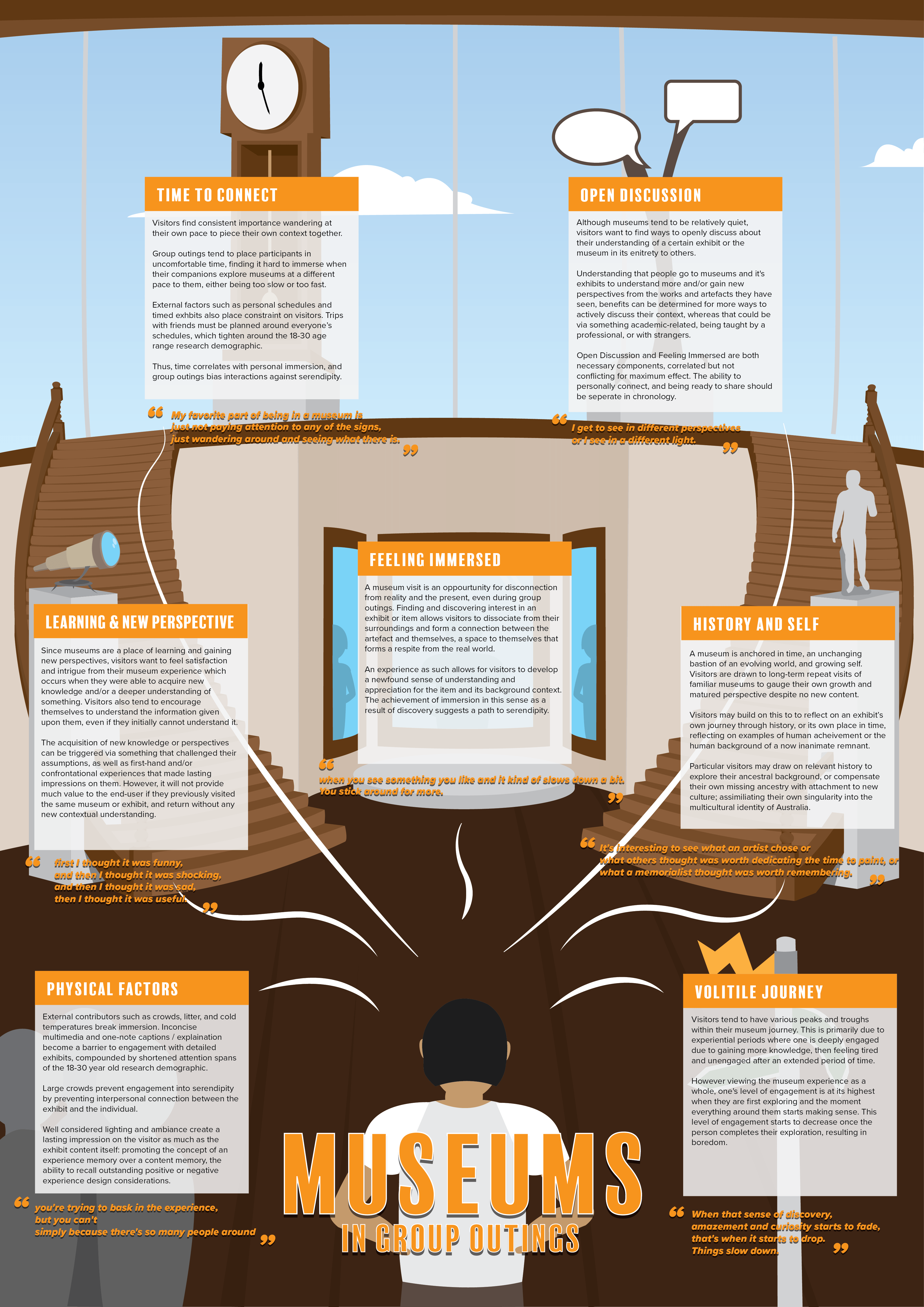
Seven insight categories were formed from statement card synthesis of our research data:
Participants commonly found importance wandering at their own pace, however seldom visited museums outside of group outings. These seemed inherently at odds.
Participants often wanted to discuss exhibits with companions, but felt limited by social expectations of museums as quiet spaces.
Participants found found diminishing value in revisting before-seen exhibits.
Participants found exhibits were sometimes disjointed from their physical space and poorly contextualised, damaging motivation and elaboration.
Participants described museum experiences as a journey, between piques and lulls of engagement, energy and interest.
Participants found particular connection with the time and spatial elements of exhibits, bridging to unfamiliar or foreign contexts.
Participants perceive a museum visit's value in the opportunity to meditate, reflect and introspect.
SOLUTION
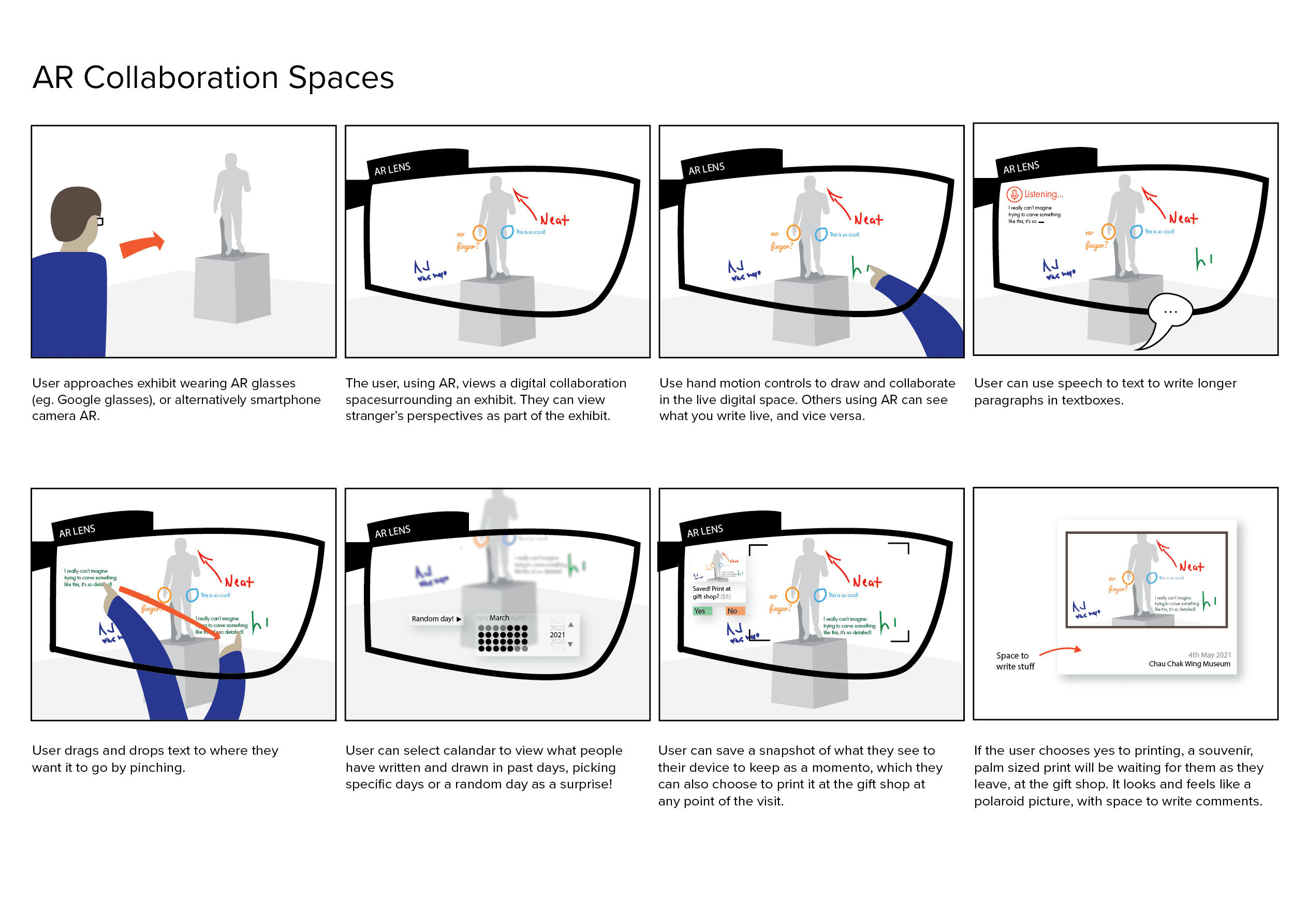
Our solution, as illustrated in this article's video, is an experiental 'phygital' element designed to facilitate our designed modification of the museum experience for our target demographic.
The phygital elements included:
Passive Ultra-Wide Band (UWB) reciever 'Journey Tracker' physical widgets
The Journey Tracker dispenser
UWB sensors disributed throughout the museum
A large 'Reflection Pool' centerpiece table. The table contains:
A large, donut/cone-shaped central screen
Journey Tracker collection pit in the center.
I 3D modelled and printed these elements to visualise them for the video demonstration.
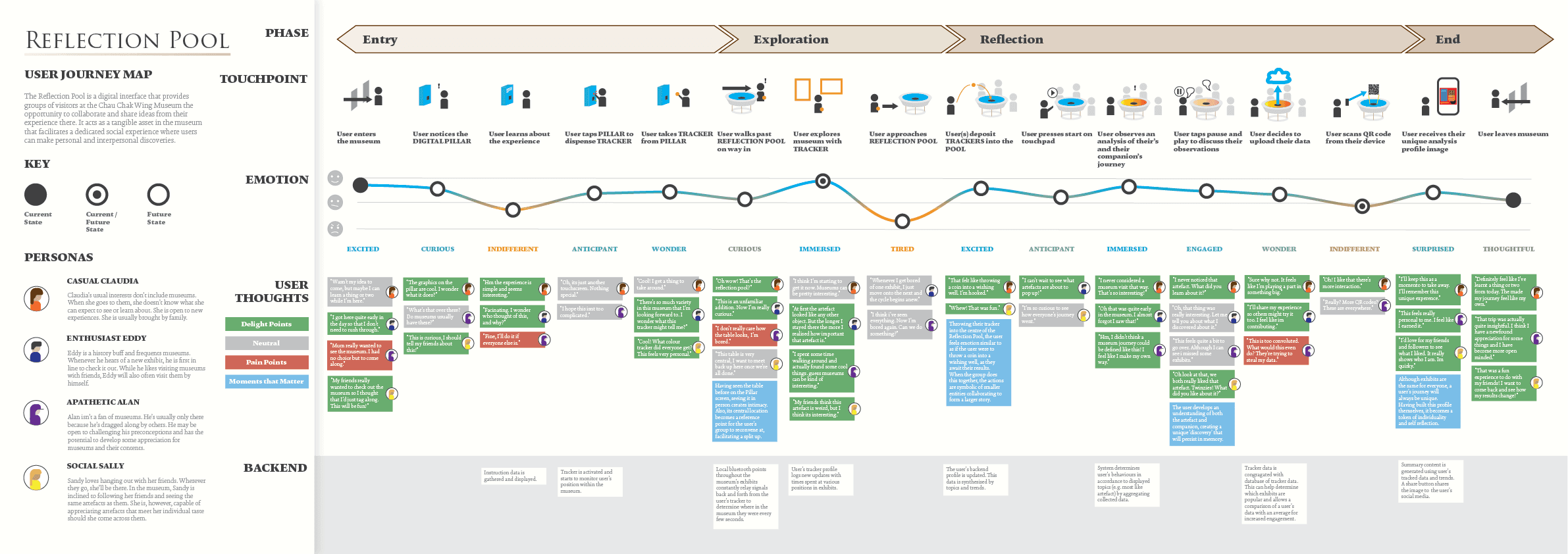
The intended experience is as follows:
The users arrive at the museum. they collect their Journey tracker and embark within the museum.
The Journey Trackers identify the user's journey; which exhibits/galleries they spend most time at, their travel path between areas, and their pace.
Afterwards, the users reconvene at the central Reflection Pool. The action of depositing their journey tracker resembles the 'serendipidous' action of skipping a stone, or throwing a coin in a wishing pond.
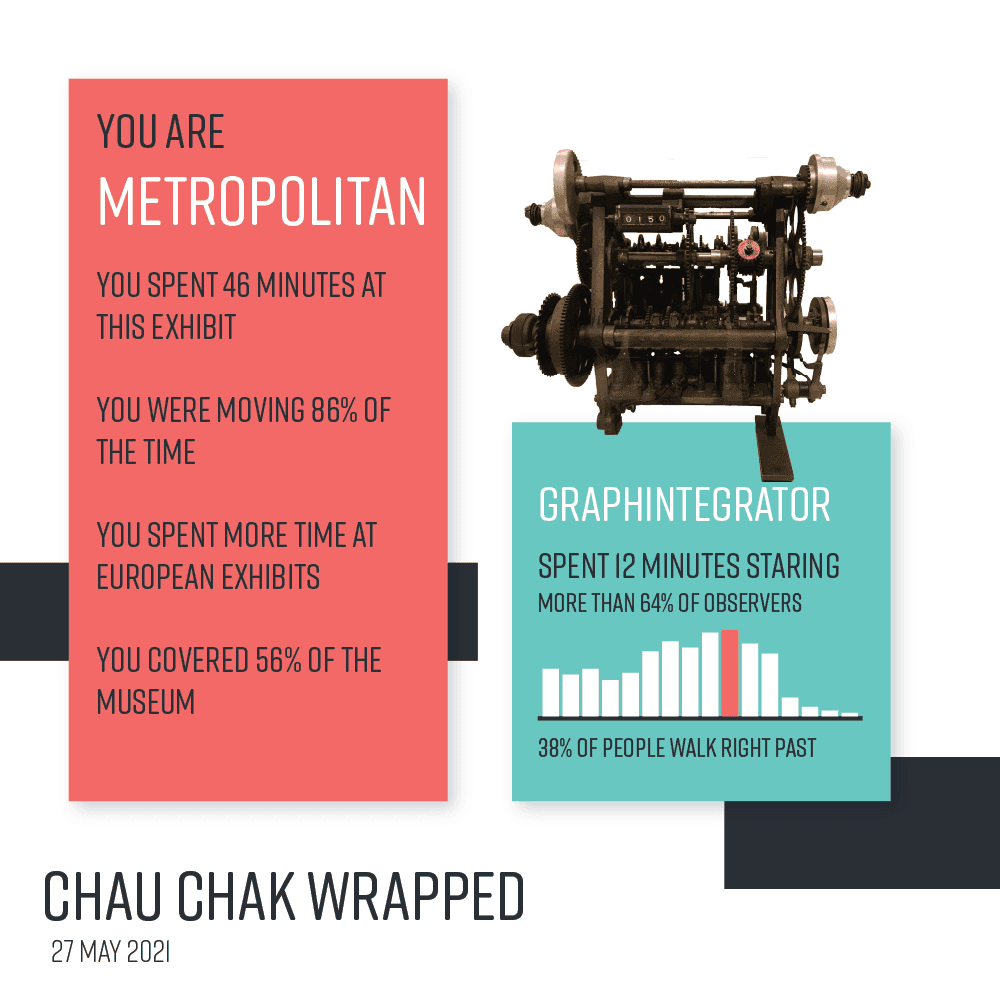
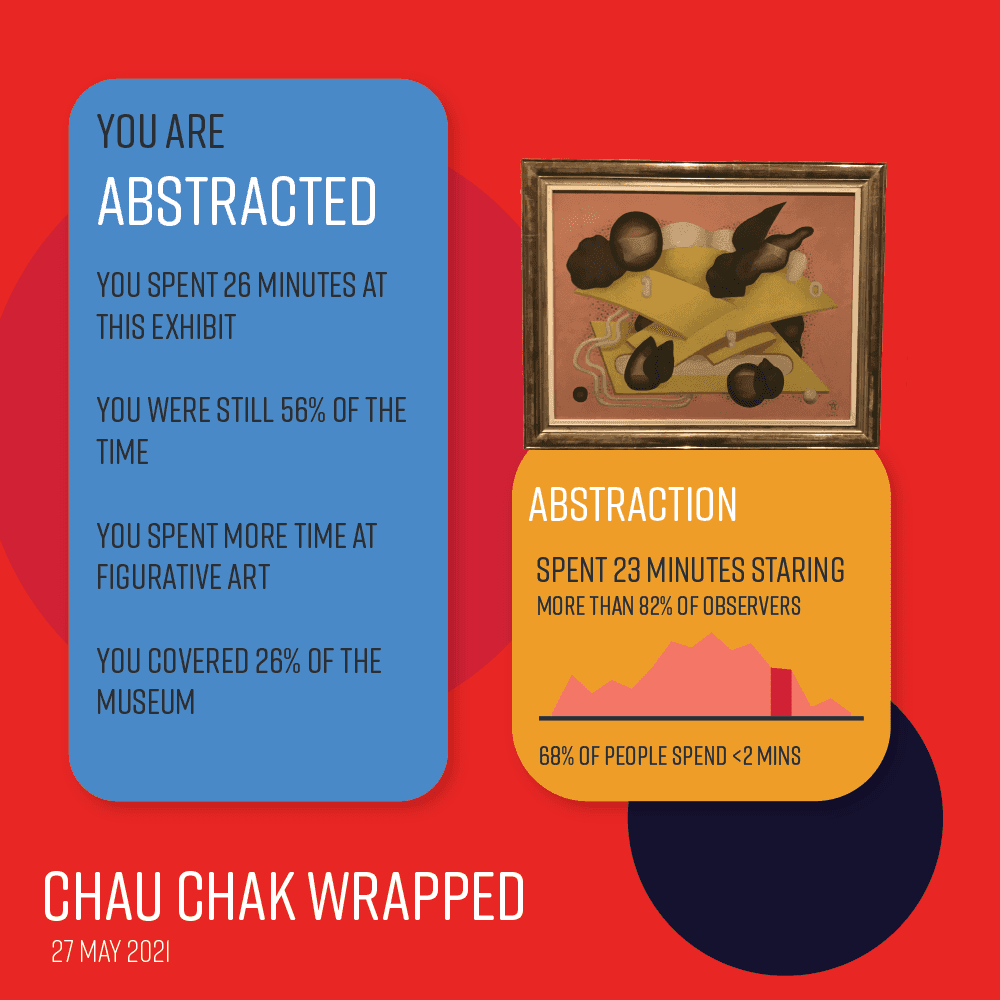
The Reflection Pool generates displays a stylised 'recap' or rewind of the user's journeys, not unlike 'Spotify Wrapped'. This is intended to faciliate group discussion and reflection. Users may scan a QR code to download this recap to remember and share.
REFLECTION
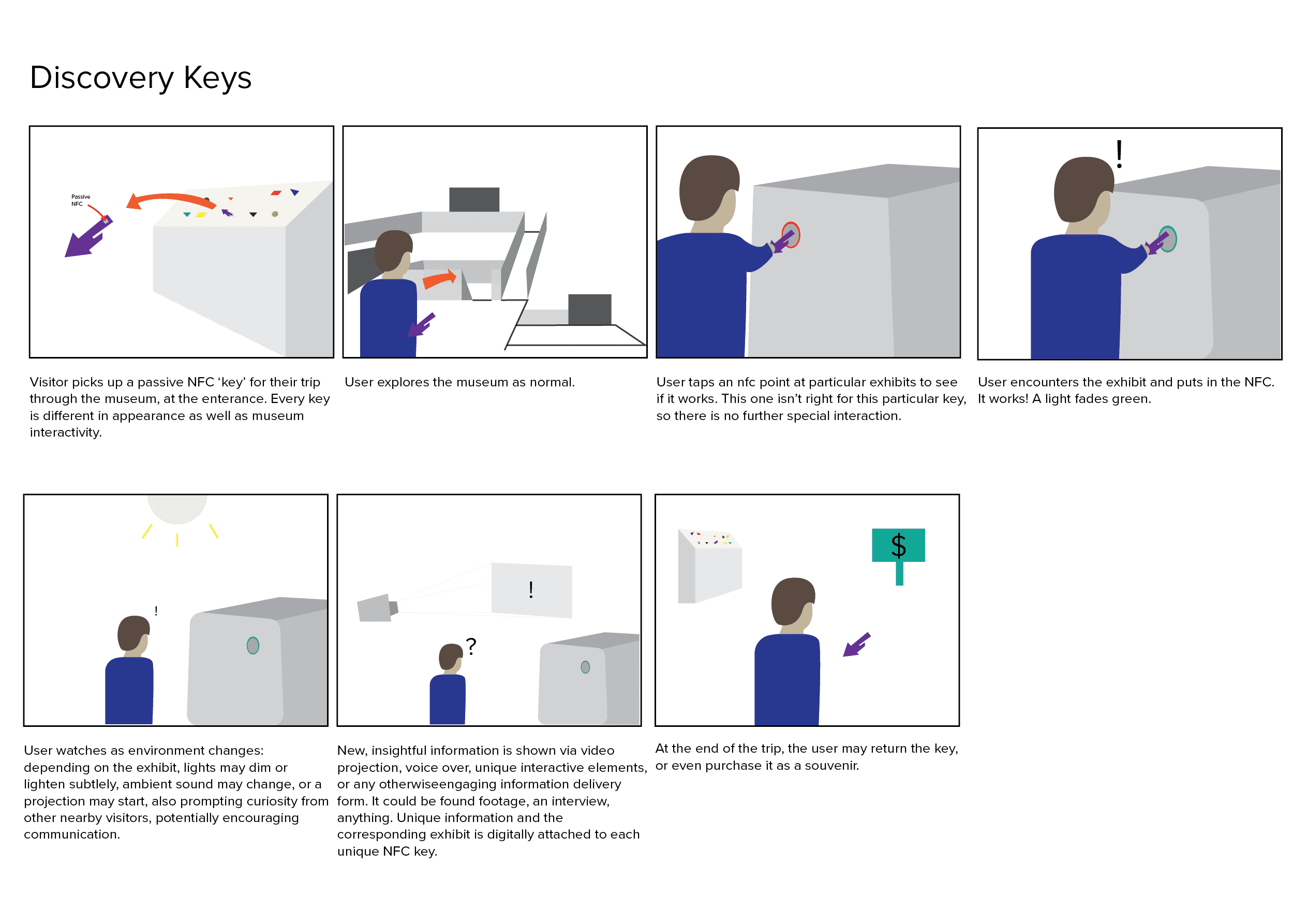
In hindsight, while the solution conforms to the parameters of our insights, I don't believe our research plan adequetely addressed the goal of "future-proofing". Our solution of a bulky physical table with many integrated support elements would take up valuable museum space, require constant maintainence and upkeep costs, and ultimately eventually become outdated.
Particularly, this solution demands an extremely high initial commitment of resources, demanding both the Journey Tracker dispenser and Reflection Pool be placed in prominent, central locations.
I believe that this is because the scope of this study was somewhat defined by educational expectations, where we exercised Forced Associations with emerging technologies, limiting our breadth of thinking towards incorporating them. Also, we felt the need to address all seven insights, which diluted the single-minded proposition of this solution.
More effectively, we could have explored ways to remix the existing contextual environments and framed towards lightweight implementations to more closely fit the original problem context.
In future, I now try harder to link each part of research back to the original context and problem, to make sure I continue to address the correct problem throughout each stage of my process.